

For years, one question kept following our client RAPID into its sales demos: “Does it have games?”
RAPID is a web-based physical therapy and rehab platform — a client’s product that we build and maintain. Its owner was the one in those rooms. He’d be walking a clinic through RAPID’s assessments and reporting — the parts we were all proud of — and then a competitor with flashy games would come up, and a deal that felt won would quietly cool.
Here’s the part people get wrong about a story like this: nobody thought games were a frivolous box to tick. We knew they mattered. But there was always something more clinically urgent in front of them — real features that existing clients needed, and that rightly jumped the queue. Games were a genuine want that could never win the priority fight, because building them the usual way was slow and expensive.
So the question I set out to answer wasn’t “are games worth it?” We knew they were. It was: how do we make them cheap enough to finally build?
How we actually built them
The answer was to stop building games and start building a factory.
I put together the piece that had been missing: a reusable foundation that turns RAPID’s pressure mat into a cursor — the patient’s body becomes the controller — with a clinical-measurement layer running underneath every frame. Get that right once, and a “game” becomes a thin, fun shell on top of machinery that’s already doing the serious work.
Then I handed the game-building to Claude. Working from that framework and reusing it for each new title, Claude became our game developer. Together, we shipped five fully tested games in two days — the feature that could never fit the budget, suddenly built over a long weekend.
Every game lives a double life
Each game is honestly fun. And each is quietly capturing the metrics a clinician actually cares about: sway path length, area of motion, left-right and front-back excursion, angles, reaction time.
That’s the whole idea in one line: looks like play, works like an assessment. Same sixty seconds, two completely different experiences — and the patient never feels the second one happen.
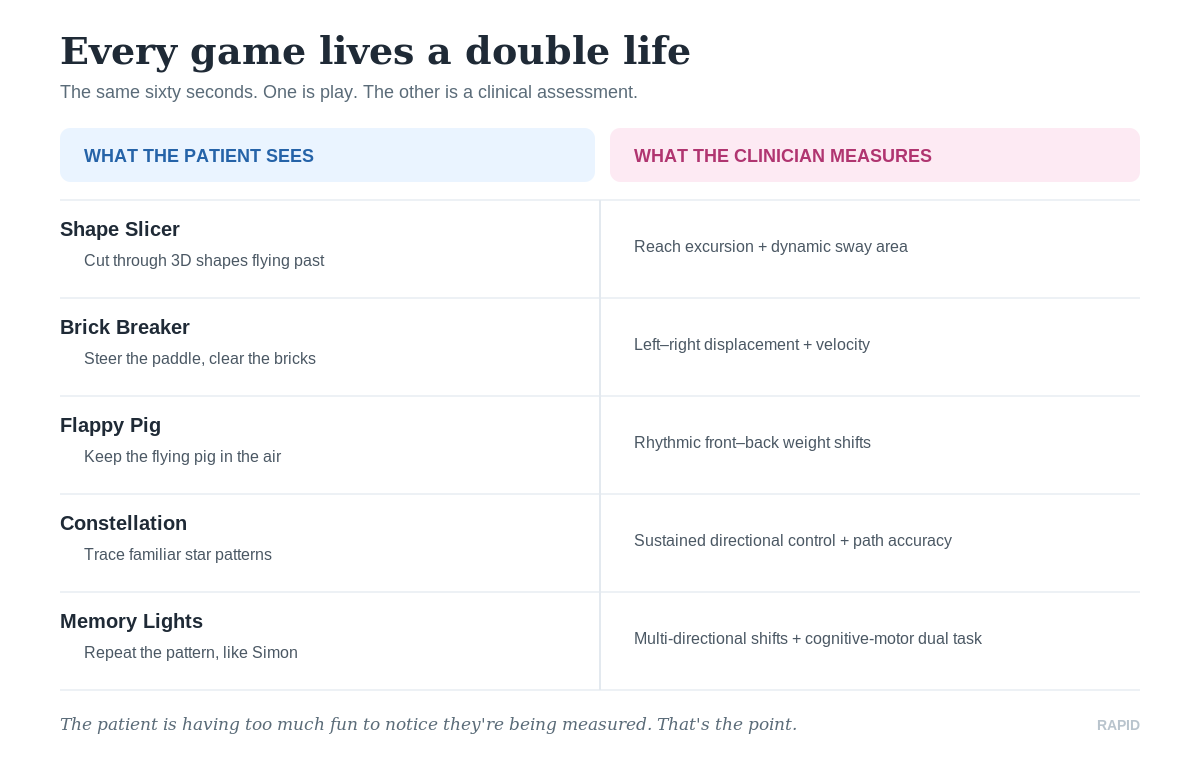
What the chart doesn’t show is why some of these matter more than others. Shape Slicer and Constellation pull the patient into big reaching movements and sustained directional control — the kind of data you’d normally chase with a clipboard and a lot of patience. Brick Breaker makes controlled left-right weight shift the entire point of the game; Flappy Pig does the same front-to-back, under just enough time pressure to keep the rhythm honest.
The one I’d put in front of a skeptic is Memory Lights. It plays like a round of Simon — but underneath, it’s a cognitive-motor dual task: the patient shifts weight in several directions while holding a sequence in mind. Doing both at once is exactly what starts to fail in fall-risk patients, and it’s notoriously hard to measure when someone knows they’re being tested. Here, they’re just trying not to lose.
The part even we underestimated
Here’s what surprised us once the games existed. We’d expected them to help with engagement — patients having fun, coming back. What we hadn’t fully appreciated is that the game is a better assessment instrument than the formal test it stands in for.
Tell a patient “stand still and shift your weight side to side” and they stop moving like themselves — self-conscious, guarded, thirty careful artificial seconds that don’t look much like real life. Put that same patient in a game where shapes are flying past and the only way to slice them is to lean, and they forget the assessment entirely. They lean farther, react faster, and do it again to beat their score — and you capture how they actually move, repeatedly, with their guard down.
So the games aren’t the candy. They’re the spoon. Engagement isn’t a layer sitting on top of the clinical product — done right, engagement is the clinical instrument. And in a field where adherence is the whole ballgame, a patient who’s having fun gives you better data and comes back tomorrow to give you more.
We also made them genuinely good
If engagement was going to be the clinical instrument, the games couldn’t be the washed-out, check-the-box version RAPID’s competitors were shipping. They had to be actually fun. So they got bright colors, real visuals, and arcade-style sound design — down to a satisfying little swoosh every time the Flappy Pig flaps its wings.
The clearest sign we were onto something didn’t come from a clinic. The owner brought his two young sons by one afternoon, and they got hold of the Shape Slicer build and didn’t put it down for almost an hour — until they had to leave. Two kids with no balance to rehab and no score that mattered to anyone, just playing. That’s the bar. If a game is good enough that someone plays it for the sheer fun of it, a patient will come back to it tomorrow — and coming back is the whole clinical point.
The part I’m actually proud of
The five games are nice. But the real win isn’t the games — it’s the factory underneath them. Those first five came over a weekend; now that the framework is proven, a brand-new game idea goes from concept to a QA-ready build — growing test suite and all — in under an hour.
That means RAPID’s library only gets richer from here, and it gets richer cheaply. The feature that could never crack the priority list turned out to be a doorway to something better: rehab that patients want to come back to, producing data that’s more honest than anything you’d get by asking them to hold still.
RAPID set out to match a competitor’s feature. Together, we ended up rethinking what that feature was even for.
A quick, honest note: these games capture motion and balance metrics that support a clinician’s assessment — they’re an instrument in the clinician’s hands, not a replacement for clinical judgment. The most rigorous measurement, it turns out, is the kind the patient is having too much fun to notice.